

It's Tuesday afternoon. Sales says there's $400K in pipeline. Marketing says it's $600K. The CRM says $290K.
The CRO is on Slack asking which number to bring to the board. Nobody has a confident answer.
This is the moment most founders first feel the absence of RevOps. Not when they read a definition. When three people report three different versions of the same quarter and the founder is the only one who can stitch the truth together.
The wrong question
Most founders Google "what is revops" and get definitions written by the same software companies trying to sell them another platform. The definitions land in two flavors. Too abstract: "the alignment of sales, marketing, and customer success." Too tactical: "the function that manages your revenue tech stack."
Neither tells you what RevOps actually does on a Tuesday afternoon when your three teams report three different numbers.
The better question is what breaks in a company without RevOps, and what the function exists to fix.
Three symptoms you already feel
The first symptom is that every team reports different revenue numbers. Sales pulls from their pipeline view. Marketing pulls from their attribution tool. CS pulls from the renewal forecast. Each team has its own definition of "qualified," "active," and "at risk." Nobody owns the source of truth, so there isn't one.
The second symptom is that handoffs leak. Marketing-qualified leads die between marketing and sales because nobody agrees what MQL means. Closed-won deals get fumbled between sales and CS because the handoff lives in someone's head. Revenue falls through the cracks between teams because nobody owns the cracks.
The third symptom is that the founder is still the most informed person about pipeline. Not because they're the best operator. Because they're the only one who can manually synthesize data from four systems into one mental model. The CRM should do this. It doesn't, because nobody has been accountable for making it.
These are not sales problems. They're not marketing problems. They're not CS problems.
They are RevOps problems. And they exist whether or not anyone in your company has the title.
What RevOps actually owns
Define RevOps not by what it is, but by what it owns.
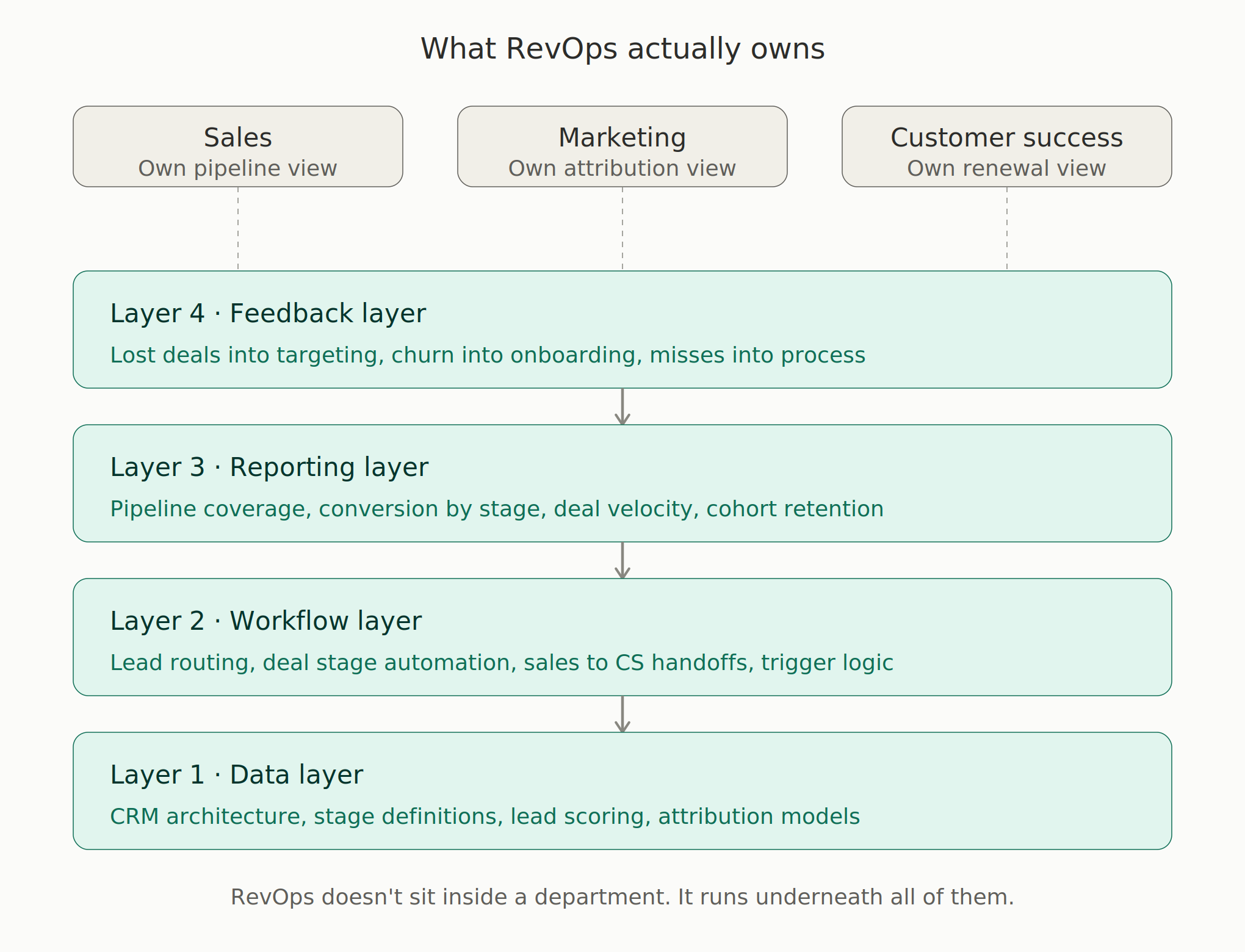
RevOps owns the data layer: CRM architecture, pipeline stage definitions, lead scoring logic, attribution models, data hygiene. The single source of truth that every other team operates from.
RevOps owns the workflow layer: how leads route, how deals progress through stages, what triggers automation, what requires human judgment, how the handoff from sales to CS actually works in practice instead of in a Notion doc nobody reads.
RevOps owns the reporting layer. Not just dashboards. The architecture of how the company sees itself. Pipeline coverage. Conversion rates by stage. Deal velocity. Cohort retention. The numbers that drive decisions, built on definitions everyone agrees on.
RevOps owns the feedback layer: the loops that turn lost deals into changes in targeting, churned customers into changes in onboarding, missed targets into changes in process. This is the layer that makes revenue compound instead of plateau.
Each layer depends on the one underneath it. Reporting is meaningless without clean data. Workflows break without reliable reporting. Feedback loops never close without all three operating together. This is why RevOps cannot be a side project for a Salesforce admin. It's an operating layer.
When you need it (and what bad RevOps looks like)
Founders ask when they should hire RevOps. The honest answer is that you needed it the moment you had more than one channel feeding pipeline and more than one person closing deals.
Most companies ignore it until $3M to $5M ARR. By that point, their CRM data has been corrupted for two quarters and it takes another six months to clean. The cost of waiting compounds quietly.
But hiring the wrong RevOps person is worse than not hiring one. Bad RevOps looks like a Salesforce admin who builds reports nobody uses, takes tickets from sales reps, and slowly becomes the person you ask to "pull a list." Good RevOps looks like an operator who can tell you why your sales cycle just got 14 days longer and which two stages of your sequence to rebuild to fix it.
Bad RevOps reacts to requests. Good RevOps owns the system and proactively rebuilds the pieces that are degrading.
The hiring trap
Most companies try to solve this with one person. A "RevOps Manager" who is supposed to be a Salesforce admin, an analyst, an automation engineer, and a strategist at once.
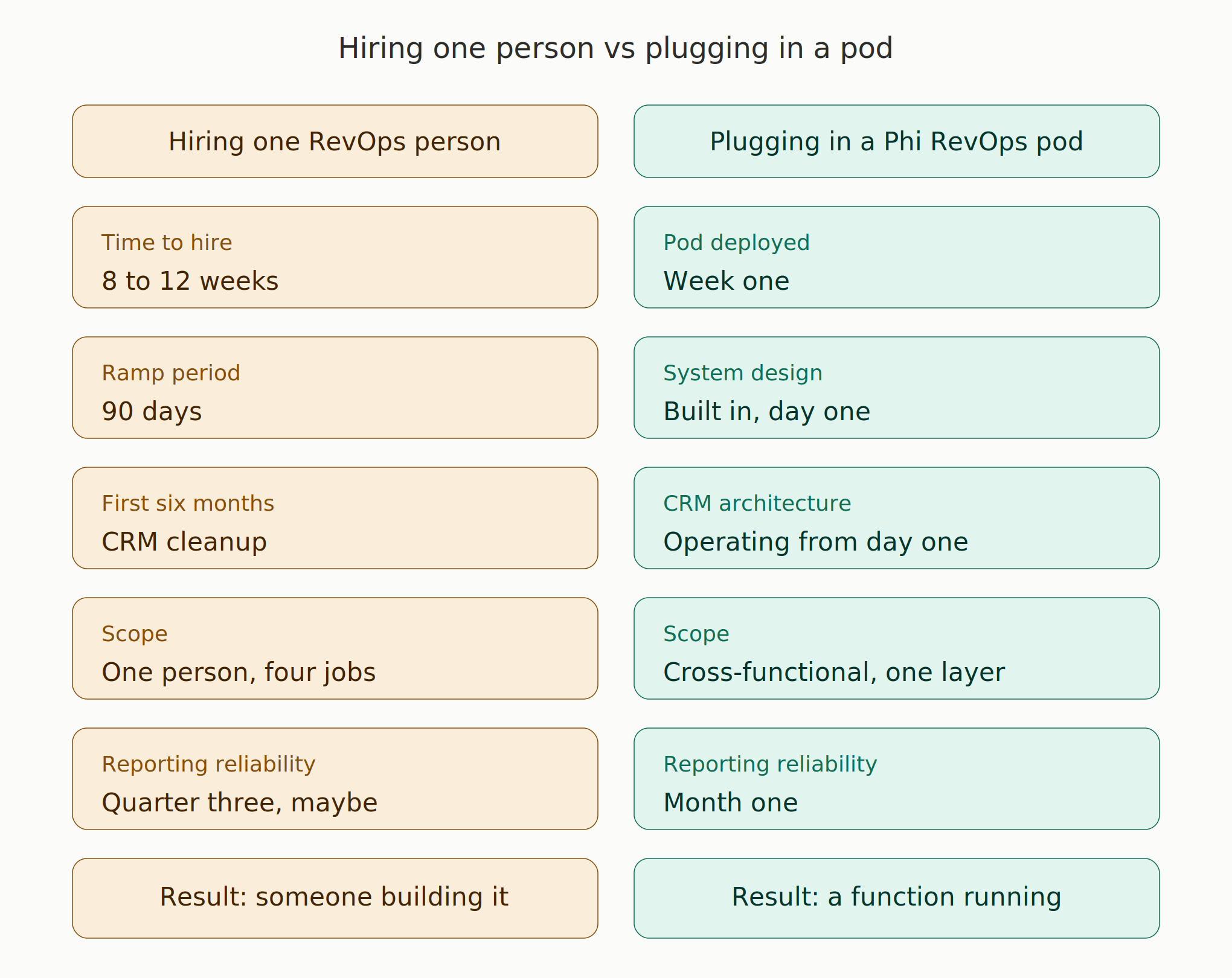
The hire takes 8 to 12 weeks to find. They take 90 days to ramp. They spend the next six months untangling the existing CRM mess before they can do anything strategic. By month nine, the CRO is asking why pipeline reporting still isn't fixed and the RevOps lead is buried in cleanup work that should have been done by an architect, not a single hire.
This is what happens when you treat a system problem like a hiring problem.
Phi deploys RevOps pods that arrive with the architecture built in. The pod includes operators who own CRM design, attribution tracking, automation workflows, and pipeline reporting as one connected layer. They plug into your existing stack (HubSpot, Salesforce, whatever you're running) and produce clean data and reliable reporting in weeks, not quarters.
No ramp period. No "let me audit your CRM for three months first." The system starts working immediately because the pod arrives as a system, not as a single hire trying to build one alone.
Hiring one RevOps person is hiring someone to build infrastructure from scratch. Plugging in a Phi pod is plugging into infrastructure that already knows how to operate.
The truth founders eventually face
RevOps stops being optional the moment a company stops being founder-led on revenue.
While the founder is the bottleneck, they hold the system together with memory and Slack threads. The minute they hand off, the absence of architecture becomes visible. Numbers stop reconciling. Handoffs stop happening. The CRO inherits a pipeline they can't trust and a team that can't agree on what's real.
Most founders treat this as a hiring problem. It's not. It's a system problem dressed up as a hiring problem. And no single hire fixes a system that was never built.
If your CRM is starting to feel like a liability instead of an asset, that's the signal. The function exists to be built before you need it, not after the data is already corrupted.

Sani Zehra
I’m a Content & SEO Specialist at Phi Consulting, where I help founders turn half-baked GTM ideas into sharp content that people actually read. Before this, I built content systems for a marketplace app, wrote AI voice agent scripts.
With an educational background in Broadcasting & Digital Media, storytelling’s been in my bones long before it became a KPI. I like clean content, clear structure and writing that doesn’t talk down to smart people.